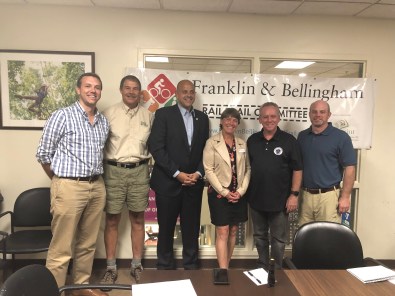
Rep. Roy & Soter along with Franklin Town Councilor Melanie Hamlin meet with the rail trail group to discuss the tunnel funding.
Funding for the Prospect Street tunnel along the Southern New England Trunkline Trail (SNETT) has been approved this week and the project will go out to bid in the fall. A total of $1.3 million, over two fiscal years, will be funded from the Department of Conservation and Recreation’s (DCR) Trails Capitol Project.
“The Southern New England Trunkline Trail serves as an important corridor that offers exceptional outdoor recreational opportunities while also connecting communities together throughout the region,” said Energy and Environmental Affairs Secretary Kathleen Theoharides. “The Baker-Polito Administration is proud to provide essential funding for the rail trail’s Prospect Street tunnel project, which will be managed by the Massachusetts Department of Conservation and Recreation, and appreciates the dedication and hard work of the Town of Franklin’s legislative delegation.”
Franklin’s legislative delegation has been actively working on this funding since 2014 in order to expand the connectivity of this trail and connect it to the rest of the SNETT. The SNETT, one of the longest trails in Massachusetts, travels 22 miles from Grove Street in Franklin all the way to the Douglas State Forest. The trail is popular to bicyclists, cross-country skiers, equestrians, and hikers and connects with other trail lines, reaching as far as Worcester, MA, Providence, RI and Palmer, MA.
“Well-maintained, accessible recreational trails have a significant positive impact on quality of life across the state,” said Senate President Karen E. Spilka (D-Ashland). “This funding will make significant improvements to the connectivity and accessibility of SNETT, encouraging people to get outdoors, be active and connect with the region.”
“As an avid bike rider, this project has always been near and dear to my heart,” said Rep. Jeff Roy (D-Franklin). “I have been advocating for the SNETT because it not offers great recreational potential as a multi-use trail and brings communities together. It also gives life to abandoned railways and provides communities a way to offer open space to its residents. I am thrilled to see that the Governor and DCR are supporting this project and look forward to seeing more residents on the trail.”
An impediment at Prospect Street emphasizes the need for a tunnel. At that point one mile into the trail there is steep terrain causing users to leave the trail, trespass on private property, and traverse a steep incline to get to the other side. Many years ago, the old railroad tracks right-of-way ran under a bridge at Prospect Street. But the bridge was eliminated, and the railroad right-of-way was filled in, creating this major obstacle.
Rep. Roy and former Secretary Matt Beaton ride the trail in 2016.
In 2013, then DCR Commissioner Jack Murray visited the site with members of the Legislature, engineers, Franklin town officials, rail trail committee members, and conservationists to discuss options. And in 2016, Matthew Beaton, the Massachusetts Secretary of Energy and Environmental Affairs, rode the trail with Rep. Roy (D-Franklin), local officials, and committee members to see firsthand whether a tunnel fit in with the Governor’s priorities.
Rep. Mike Soter (D-Bellingham) stated, “I’m thrilled to see this project finally move towards reality. This has been in the works for years now and I cannot express enough how happy I am to see this project through as the State Representative of the 8th Worcester District. The Southern New England Trunkline Trail is an outstanding project that promotes environmental stewardship and healthy living for the residents of Bellingham and the surrounding communities.”
Senator Becca Rausch (D- Needham) said, “One of the best parts of our pocket of the Commonwealth is its natural beauty. This project not only improves lives in our area by fixing a problem spot for accessibility, but also serves as a draw to others to come visit our region. I’m so proud to support the tremendous work of my colleagues at the state and local levels who have brought this trail to reality.”
“I want to thank our state legislative delegation and the Franklin-Bellingham Rail Trail Committee for all of their tireless work to get these resources to provide better access to the SNETT trail,” said Franklin Town Administrator Jamie Hellen. “On behalf of our entire staff and the Franklin DPW, we have been honored to work on this exciting project. There is no question this is a very big deal and we are committed to continuing to work on expansion of the SNETT in the future.”
“The Franklin & Bellingham Rail Trail Committee (FBRTC) is proud to be the community advocate for the SNETT and the funding of the Prospect Street tunnel project,” said Marc Kaplan, FBRTC president. “The tunnel project solves a major impasse on the SNETT and creates a seamless connection between the towns of Franklin and Bellingham. The completed project helps realize our mission of making a universally accessible trail for all ages and abilities and will improve the quality of life for residents. We would like to thank Representatives Roy and Soter and Senators Spilka and Rausch, as well as Franklin and Bellingham Town administrators for their leadership to secure funding for this important project, and the DCR for their tireless work and direct assistance in developing the SNETT rail trail.”
The project will go out to bid in November 2019 and the project should be complete by the summer of 2020.
Long before the era of “fake news” or Twitter bombs, the freedom of the press often had to be defended with pens and pistols.
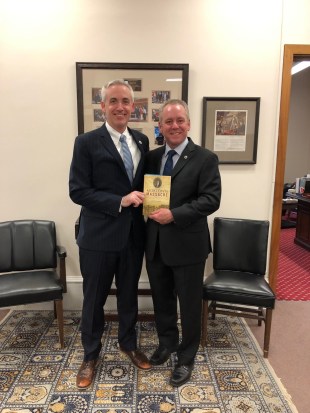
In his book Mobtown Massacre: Alexander Hanson and the Baltimore Newspaper War of 1812, author and State Representative Josh Cutler shares the story of how one Massachusetts town came to be named for a fiery Federalist newspaper editor from Maryland whose anti-war writings provoked a bloodthirsty mob, a midnight jailbreak and a brutal massacre that stunned the nation in 1812. This fateful but little-known episode in American history helped shape the course of a war and the nation’s promise of a free press. And it all started with a headline.
On Sunday, September 15, 2019 Rep. Cutler will join Rep. Jeffrey Roy (D-Franklin) at the Franklin Historical Museum to talk about the book and this fascinating period in American history.
“I am honored to bring Rep. Cutler to Franklin to shine light on a little-known episode in American history that helped shape the course of war and the free press,” noted Rep. Roy. “His book is a gripping story of the press under attack, a fiery young editor who put his principles above popularity, and a challenge to populist thought that brings history to life. The book also foreshadows the toxic political arena in America today, but stands as a shining example of political courage.”
Rep. Cutler is an attorney and serves in the Massachusetts House with Rep. Roy. Cutler represents the Sixth Plymouth District of Massachusetts, which includes the town of Hanson. Cutler is a graduate of Skidmore College, Suffolk Law and the University of Massachusetts at Dartmouth. He is also the author of “When the Press Really Was Under Attack: Alexander Hanson and the 1812 1Mobtown’ Massacre,” published by the New England Journal of History in the Spring 2018.
Much has been written and said about mosquitos and EEE over the past few weeks and our office has been staying on top of the issue with regular updates from the Department of Public Health (DPH). Mosquito control activities are continuing across the state to reduce public health risk from EEE, including local coordination regarding enhanced ground and truck spraying and ongoing monitoring of mosquito samples.
Ground spraying is planned and carried out by local communities and mosquito control projects and districts. In our area, we have the Norfolk County Mosquito Control District (NCMCD) which represents the interests of the member communities and their residents. They have a robust website with vast resources which you can access by clicking here. Any resident can call the NCMCD at (781) 762-3681, Monday through Friday during regular office hours (7:00 AM to 3:30 PM), to register a mosquito complaint. As an alternative, residents can request service online from the Online Service Request Form.
DPH maintains a EEE website which has many helpful resources, including the latest EEE risk map, aerial spraying information, and recommended cancellation times for outdoor activities in high risk areas.
It remains essential that individuals take personal precautions against mosquito bites. These steps include using EPA-approved bug spray, wearing long sleeves and pants outdoors to reduce exposed skin, and cancelling outdoor activities in the hours from dusk to dawn when mosquitoes are most active.
Learn more about EEE in Massachusetts and how to protect yourself and your family. Visit DPH’s EEE page and follow @MassDPH on Twitter for the latest information. If you have any trouble accessing information or would like additional information, please do not hesitate to contact my office at 617-722-2030.
Jennifer Knight-Levine was honored Tuesday as a member of the Massachusetts Commission on the Status of Women’s 2019 class of Unsung Heroines. Jennifer was nominated by Representative Jeffrey Roy (D-Franklin) because of her years of dedicated service and for her role in founding the SAFE Coalition and helping people struggling with substance use disorder in Franklin and surrounding communities. Jennifer was honored with 130 other Unsung Heroines in a ceremony in the Great Hall at the State House in Boston.
In 2014, Jennifer had recently returned to Franklin, and was astonished to hear the heartbreaking stories of those struggling with heroin addiction in the community. She urged the creation of a warm, kind, and sustainable education platform for this matter. She envisioned a support system for people to come together to grieve and heal. From that, Jennifer went on to become one of the founders of the SAFE Coalition, a regional coalition of community partners who provide a pathway for support, education, treatment options and coping mechanisms for those affected by substance use disorder.
The Coalition has grown in the past 5 years, becoming one of the strongest in Massachusetts. The Coalition provides “Community Conversations” about substance use and prevention, Support Groups, a Support Telephone Line, Narcan training, a High School Peer-to-Peer Advisory Group, and a comprehensive Resource Manual for those suffering from the disease of addiction. Jennifer now serves as the SAFE President and through her efforts many lives have been saved and many people are on the pathway to recovery
“Jennifer’s great work with Franklin’s substance use disorder community provides peace of mind for countless families, a supportive space for people coping with addiction, and a place for education on substance use disorder,” said Representative Jeffrey Roy (D-Franklin). “Throughout her years of service, she has given her time, talent, spirit, and enthusiasm to enrich the lives of Franklin’s recovery and addiction community.”
“It was an absolute honor to stand with these 129 incredible woman from around the state and to be recognized as an Unsung Heroin for 2019 by the Massachusetts Commission on The Status of Women,” said Jennifer Knight-Levine. “I was moved during each of the nominees’ introductions and was humbled by the stories of resilience, dedication, and compassion each provide to their communities. I am so thankful that Rep. Roy nominated me for this award and so proud to have the opportunity to continue the community work that I know my grandmothers would be proud of.”
“The work of the 2019 Unsung Heroines has mattered long before this day and this award is an overdue recognition of their impact. Each and every one of the Honorees has and continues to sacrifice endless time and energy to their pursuits, and for that, we are humbled with admiration.” Chair Nina Kimball, Massachusetts Commission on the Status of Women.
The Unsung Heroines are women who do not always make the news, but make a difference. They are the women who use their time, talent and enthusiasm to enrich the lives of others and make a difference in their neighborhoods, cities and towns. They are mentors, volunteers and innovators who do what needs to be done without expectation of recognition or gratitude. These women are the glue that keeps a community together and every community is better because of their contribution.
Representative Jeffrey N. Roy (D-Franklin) was named to the Harm Reduction Commission by House Speaker Robert A. DeLeo and Rep. Denise Garlick, Chair of the Committee on Mental Health, Substance Use and Recovery. The commission was included as part of Chapter 208 of the Acts of 2018, legislation which addresses prevention and access to appropriate care and treatment of addiction. The commission will review and make recommendations regarding harm reduction opportunities to address substance use disorder.
“Representative Roy is an innovative and thoughtful legislator with demonstrated, in-depth knowledge of both healthcare and the law. We’re proud that he was named to this commission as he will bring value to its work,” said Speaker DeLeo. “He has been a steadfast supporter of the recovery community and has focused on combating the opioid crisis and improving our healthcare system to best meet the needs of patients. We appreciate his dedication and service to our Commonwealth.”
“I am excited to join the commission and continue working toward the goal of helping those with substance use disorders find a pathway to recovery,” said Representative Roy. “The findings from the commission’s report will be important in addressing this issue at the local and state level and will provide meaningful opportunities for our residents who are struggling with addiction.”
“The harm reduction commission will take a closer look at how to engage people at all stages of substance use disorder and encourage recovery,” said State Representative Denise C. Garlick (D-Needham), Chair of the Joint Committee on Mental Health, Substance Use and Recovery. “Representative Roy is a member of the Joint Committee on Mental Health, Substance Use and Recovery and has been a dedicated, compassionate advocate for his district and a leader with experience and insight through the enactment of the opioid bill. Representative Roy is committed to helping individuals who are suffering, families who are struggling and communities straining to meet the many needs of people of all ages dealing with the issues of addiction. I believe his perspective will be invaluable to the people of his district and to the Commission’s work.”
The commission consists of 15 members, including the secretary of health and human services; the commissioner of public health; house and senate members of the joint committee on mental health, substance use and recovery or their designees; the mayor of the city of Boston or a designee; the mayor of the city of Cambridge or a designee; and representatives from the Massachusetts Medical Society, the Massachusetts Health and Hospital Association, and the Massachusetts Chiefs of Police Association. It also includes persons with a substance use disorder, a clinician with experience in mental health and substance use disorder, a person working in an established harm reduction program, an expert in relevant state and federal law and regulation, and a representative of local municipal boards of health. In its work, the Commission will consider:
the feasibility of operating harm reduction sites in which (A) a person with a substance use disorder may consume pre-obtained controlled substances, (B) medical assistance by health care professionals is made immediately available to a person with a substance use disorder as necessary to prevent fatal overdose, and (C) counseling, referrals to treatment and other appropriate services are available on a voluntary basis;
the potential public health and public safety benefits and risks of harm reduction sites;
the potential federal, state and local legal issues involved with establishing harm reduction sites;
appropriate guidance that would be necessary and required for professional licensure boards and any necessary changes to the regulations of such boards;
existing harm reduction efforts in the commonwealth and whether there is potential for collaboration with existing public health harm reduction organizations;
opportunities to maximize public health benefits, including educating persons utilizing the sites of the risks of contracting HIV and viral hepatitis and on proper disposal of hypodermic needles and syringes;
ways to support persons utilizing the sites who express an interest in seeking substance use disorder treatment, including providing information on evidence-based treatment options and direct referral to treatment providers;
other harm reduction opportunities, including but not limited to, broadening the availability of narcotic testing products, including fentanyl test strips;
alternatives and recommendations to broaden the availability of naloxone without prescription; and
other matters deemed appropriate by the commission.
The Commission will also review the experiences and results of other states and countries that have established supervised drug consumption sites and other harm reduction strategies and report on the impact of those harm reduction sites and strategies.
The Commission’s first meeting is scheduled for October 24, 2018 and its findings and recommendations are due to the legislature by February 1st, 2019.
The Town of Franklin hosted the Massachusetts Cultural Council for a site visit of the proposed Franklin Cultural District on September 20, 2018, the last step in the process to establishing an official, State-designated Cultural District in Franklin.
The Franklin Cultural District (FCD) will be a demarcated region within the town that encompasses the cultural facilities, activities, and assets that lie in a compact, walkable area. Franklin’s vibrant cultural atmosphere is already home to the nation’s first public library, the Franklin Historical Museum, Dean College School of the Arts, over 25 other performing, visual arts and dance studios and associations, and a variety of restaurants and cafes. Establishment of the FCD will likely attract additional arts and cultural organizations in the future, driving economic development.
Cultural District status will make the FCD eligible for a variety of state grant programs, state economic development opportunities and monies, strategic planning and historic preservation assistance, and marketing through the Massachusetts Office of Travel and Tourism.
This effort has been years in the planning, beginning with the Franklin Cultural District Steering Committee, who were tasked with gauging interest in the project and starting the organizational efforts necessary to begin the application process. The Steering Committee met with potential partners, the Massachusetts Cultural Council (MCC), and Town of Franklin administrators to determine the needs, geographic area and types of businesses to be included, and the roles and responsibilities of the District itself. A preliminary site visit with the MCC and the Town resulted in a decision to move forward with the formal cultural district application.
On June 28, 2017, the Franklin Town Council passed Resolution 17-45, which endorsed the FCD’s cultural district goals, namely to “attract artists and cultural enterprises; encourage business and job development; establish the district as a tourist destination; preserve and reuse historic buildings; enhance property values; and foster local cultural development.” The FCD will be managed by a Town-appointed Franklin Cultural District Committee, made up of seven Franklin residents, established in November 2017.
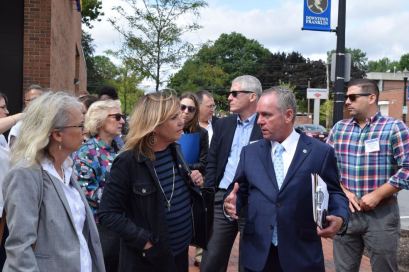
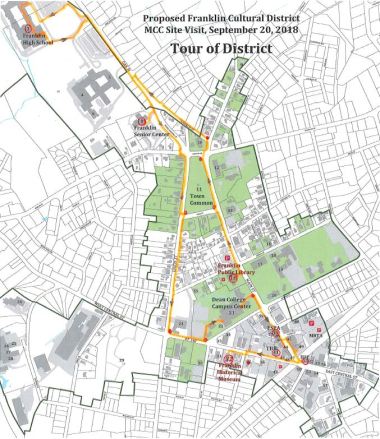
The FCD Committee filed a formal application for Cultural District status with the State in June of this year. After the application was reviewed, the MCC scheduled a final, more detailed, site visit, the last step in the process. The site visit, held on September 20, began with a meeting between Anita Walker, Executive Director of the MCC, and the complete MCC Communities staff, Franklin Town administrators, and members of the FCD Committee to discuss the District’s potential impact on arts and economic development in the area. Then followed a walking tour of key District partners’ facilities, led by MA State Rep. Roy.
“It is inspiring to see that the idea for a Cultural District has blossomed, and know that this tour will be the capstone presentation for the State approval process,” said Representative Jeffrey N. Roy (D-Franklin). “Arts and culture are essential, as they help us better understand and interpret the world around us, they improve our ability to think critically and act creatively, and they offer the opportunity to see and communicate better. Having designated space for cultural enrichment will also be an economic boost for our community and spread the message that Franklin is a place where culture is thriving. I applaud the committee for its hard work over the past five years, and thank them for their commitment and dedication to the District.”
The walking tour began at the Franklin Public Library, and included stops at the Franklin Historical Museum, Franklin Downtown Partnership offices, The Black Box and Franklin School for the Performing Arts, Franklin Senior Center, Franklin High School, Teddy Gallagher’s, Emma’s Quilt Cupboard, The Little Shop of Olive Oils, and Dean College.
Says Dr. Paula Rooney, President of Dean, “Dean College is proud of our long history in the town of Franklin and excited about the Franklin Cultural District. Dean’s impact is significant in Franklin from both an educational and cultural perspective, and our geographic location serves as a meaningful footprint within the district. We look forward to doing whatever we can to make this endeavor a continued success.”The site visit ended with a Q and A session and meeting of many of the FCD partners with the State MCC representatives. Now that the MCC has reviewed the application and conducted a site visit, the State can render a verdict on the application. A decision should be announced early in 2019.
“The site visit went very well,” says FCD Committee Chair Philip Regan, “We are pleased by the State’s response to our application, and are excited by what the advent of a Cultural District could do for the Town of Franklin.”
The Legislature marked the end of a productive 2017-2018 legislative session, passing major bills relating to criminal justice, civics education, gun safety, substance use disorder, women’s rights, economic development, veterans’ benefits, consumer data protections, and energy and the environment.
“It was a robust two years as we tackled a host of issues to keep Massachusetts at the top of the heap,” noted Rep. Jeffrey N. Roy (D-Franklin). “Amid a charged national political atmosphere, we were able to agree to a fiscally-responsible budget and our state remains a great place to live, work and raise a family. Our legislation increases public safety, enhances opportunities for our citizens, and supports children, first responders, veterans and small businesses.”
Resting on a longstanding practice of strong fiscal management, the House passed two balanced state budgets – with landmark investments in early education, benefits for low-income families, workforce development, housing as well as programs to prevent and treat opioid addiction. These included no new major taxes. This year the budget surplus increased the state’s Stabilization Fund, which is expected to surpass $2 billion in Fiscal Year 2019.
This past spring the House passed the most comprehensive criminal justice reform legislation in a generation to establish a more equitable system by supporting our youngest and most vulnerable residents, reducing recidivism, increasing judicial discretion, and enhancing public safety.
As part of the reforms, the House also acted on its longstanding legacy of supporting the Commonwealth’s most vulnerable children by raising the minimum age of criminal responsibility from age seven to age twelve and decriminalizes first offense misdemeanors.
The reforms also bolster the House’s multi-tiered approach to combatting the opioid epidemic by creating the nation’s strongest law for trafficking Carfentanil and by strengthening the Fentanyl trafficking law. The legislation requires district attorneys to create pre-arraignment diversion programs for military personnel, veterans, and individuals with addiction or mental health issues. It removes the age restriction to participate in a diversion program, as they are currently only available to defendants 22 and under.
The legislation also includes the following provisions.
For the first time in the history of Massachusetts, this legislation establishes a process for expunging criminal records.
Courts will now be able to expunge the records of certain juvenile and young adults aged 18 to 21, and records in cases of fraud or where an offense is no longer a crime.
The reforms eliminate mandatory and statutory minimum sentences for many low-level, non-violent drug offenses.
The legislation also toughens penalties for repeat offenders convicted of operating under the influence (OUI).
Updates the Commonwealth’s Criminal Offender Record Information (CORI) system to help individuals secure gainful employment and housing.
With the tragic events resulting from mass shootings unfolding across the country, the House took action twice this session to pass Massachusetts’ already nation-leading policies designed to promote gun safety. This session Massachusetts took another leap forward with new laws aimed at preventing those individuals who pose a risk of causing bodily injury to themselves or others from owning or possessing a firearm as well as providing them with crisis intervention, mental health, substance abuse and counseling services. In addition the House passed legislation banning the sale, purchase or ownership of a “bump stock” device, which is designed to increase a weapon’s rate of fire and mimic automatic gun fire.
These laws build on the House’s landmark 2014 gun legislation, which led to Massachusetts being found one of the safest in the nation.
While focused on protecting our residents from gun violence, the House took action to address the opioid crisis with sweeping initiatives to promote behavioral health for adults and children and measures to prevent substance use disorders. The legislation takes takes steps to strengthen community-based prevention of substance use disorders and promote healthy behaviors; measures including expanding access to non-opioid treatment options for pain management; establishing grants to benefit substance exposed newborn children; and prohibiting discounts and rebates for certain prescription opioids. It also takes steps to improve the quality of patient care at treatment facilities, expands access to Narcan and increases training for law enforcement to respond to behavioral health crisis.
Building off its tradition of protecting women’s rights, the House passed landmark legislation to guarantee reasonable accommodations and safety measures for pregnant workers. With an uncertain future for federal action on reproductive rights, the Legislature took decisive action to protect the rights for women across the Commonwealth by passing legislation to make Massachusetts the first state in the nation to repeal outdated state laws directed at limiting a woman’s right to make decisions about her own reproductive health.
Renewing its dedication to balancing the needs ofworkers and small businesses, the House passed legislation to raise the minimum wage; create a framework for paid family and medical leave for most workers; and to establish a permanent sales tax holiday.
Facing an unprecedented number of data breeches across the nation from national credit reporting entities and retailers, the House passed a bill to put into place enhanced protections for consumers against data breaches, making it easier for consumers to monitor their credit and request security freezes on data. The bill requires entities that have been breached to limit fees associated with data breach protections as well as requires transparency from breached companies and their affiliates. In addition, breached entities are required to provide more detailed consumer notifications about data breaches and options to help consumers better protect themselves.
Recognizing the critical needs of the Commonwealth’s first responders, the House passed a bundle of bills aimed at supporting enhanced police training, provisions to protect firefighting men and women as they recover from work-related cancer illnesses and providing access to confidential mental health services for those responders recovering from traumatic events.
The House also passed legislation to spur economic development across the Commonwealth with investments including public infrastructure projects like street and sewer improvements and for multi-family housing and mixed-use development, and transportations in communities across the Commonwealth. The legislation also includes investments to grow jobs coastal communities; fund; boost manufacturing innovation; support technology development and innovation; and expand career technical training programs. The legislation also establishes and apprenticeship tax credit for employers and limits the enforcement of and sets standards for non-compete agreements in Massachusetts. The legislation funds initiatives that help small businesses grow and establishes tax credits for businesses that occupy vacant storefronts in downtown areas.
This session the House took action to foster an inclusive and just elections process by establishing automatic voter registration.
In response to calls for increased awareness of students of how the U.S. democratic system works at the local, state and federal government levels, the House passed a bill requiring schools to incorporate civics education with a focus on hand-on learning voting activities and media literacy.
As part of an ongoing effort to protect the health of our youth, only those aged 21 or older may purchase tobacco products in Massachusetts as a result of the Legislature’s action on this issue.
Massachusetts is a known national leader in environmental policy and this year’s environmental bond bill bolsters that position by dedicating $2.4 billion to improving climate change resiliency and adaptation; enhancing environmental and natural resource protection; and investing in parks and recreational assets. The legislation passed ensures that Massachusetts can continue to plan for global warming and a changing climate, including along vulnerable coastlines with $225 million in community investment grants, $100 million for energy and environment coastal infrastructure, and $54 million in rural investments.
This year the House passed a bill to enhance certain benefits for Massachusetts veterans including increases to assistance with funeral and burial expenses; relating to property taxes, and designating April 5 as Gold Star Wives Day and the last Sunday in September to Gold Star Mothers and Families Day.
Fiscal Year 2019 Budget Highlights
Education
$4.9 billion in Chapter 70 education funding, which represents an increase of 3.4 percent over the previous fiscal year and increases funding for employee health care costs by $39 million.
$319.4 million to fund the Special Education Circuit Breaker, $90 million for Charter School Reimbursement.
$68.9 million for Regional School Transportation.
$10 million to create an EEC community college workforce development initiative.
Children and families
Lifts the cap on benefits for children of low income families.
$2.5 million for continued support for early childhood mental health consultation services
$20 million to support high-quality Early Education and Care (EEC) programs.
Housing
$100 million for the Massachusetts Rental Voucher Program (MRVP).
$32 million for the HomeBASE program.
$20 million for the Residential Assistance for Families in Transition (RAFT) Program.
$5 million rapid homeless rehousing program.
Opioid epidemic
$142 million for the Bureau of Substance Addition Services to create five recovery centers in Massachusetts.
$5 million to support community-based treatment program.
$4.9 million for step-down recovery services.
$1 million to provide increased access to Narcan to first responders.
Transportation
$88 million to fund Regional Transit Authorities across Massachusetts to assure that our residents have access to reliable and affordable transportation.
State Police Oversight
Sets aside funds to establish monitoring for hiring, promotion and preferential treatment occurring within the State Police and establishes an internal audit directed by the Inspector General of the Commonwealth to prevent the abuse of public money.
Locally, the FY19 budget includes the following priorities for Franklin and Medway:
$50,000 for the Franklin Veterans’ War Memorial Parkway
$200,000 for King Street Park in Franklin
$100,000 towards the New England Center for Children Partner Program at Parmenter Elementary in Franklin
$25,000 for the Franklin Downtown Partnership
$50,000 for an Accessible Van for Tri-County
$100,000 for the construction of a new Department of Public Services Building in Medway
$50,000 for the T.H.R.I.V.E. Substance Abuse Prevention Program in Medway
$25,000 for the Medway Community Farm
$22,000 for an upgrade of the Communications and Pager Technology at the Medway Fire Department
$50,000 for the MetroWest Veterans District
$35,000 for the Medway Historical Society
$21,000 for the Senior Citizens Health and Safety Program in Medway
The Massachusetts House of Representatives has been very active in trying to address issues raised by the Foundation Budget Review Commission (FBRC) about education spending. In fact, on July 10, the House voted 143-0 to approve a bill addressing the FBRC recommendations.
The House bill provides roughly $500 million to school districts over five years to help cover a greater share of the costs associated with special education and the health benefits for employees and retirees (both big issues in Franklin and Medway).
On the issue of adding more money to help low-income students in districts that have a high concentration of poverty and English-language learners (or ELLs), the House bill directs the state education commissioner to develop a plan for implementing the recommendations and helping those students. The plan would be due by the December 2018 for consideration in the fiscal 2020 budget. The House wants that report (due in 6 months) before committing to a timeline for implementing those particular recommendations.
Some have suggested that we should just fund all four buckets immediately. In fact, one proposal had the state just writing checks to districts. That proposal lacks the language found in the House proposal that would direct the state’s education commissioner to identify and recommend interventions for ELL and low-income students that work and, if s/he chose, to tie incentives for reform to the new funding.
Boston officials raised concerns during negotiations that the proposed changes could have cost the city millions of dollars. Also, it was clear that some of the estimated costs of the various proposals being negotiated were off by hundreds of millions of dollars. Moreover, if the state increased the foundation budget levels on which the formula is based, the per-student tuition amounts to charter schools would have gone up as well.
Given these factors, it is necessary and reasonable to do the proposed 6-month study, with a report due in December 2018. Then the actual costs could be determined and a plan for implementation could be developed in time for the FY20 budget which gets prepared in January 2019.
It was a great honor to work on and be a part of the team in presenting the 160 page reform bill that addresses some of the most pressing concerns in our healthcare system today – price variation, unnecessary cost growth, consumer engagement, and greater transparency. The bill also harnesses technology and innovation to improve the delivery of care. The reforms were engrossed by the House in a 117-32 vote.
The reforms in this bill will help us deliver more sustainable methods of improving health care in Massachusetts. The Massachusetts approach to health reform is not about squeezing out efficiencies and cutting cost, rather it is transforming how we seek to pay for care to promote cost-effective, value driven services in a way that makes the healthcare system more accessible and effective for all of us.
We continue to be a leader in health care and public health areas and this bill will indeed move us further along towards increased accessibility, higher quality, and more affordable health care for all.
The bill includes policies that will help stabilize the finances of community hospitals and health centers to help these critical providers of care to transition to the new models of integrated, value-based care. It contains new requirements for consumer engagement and greater transparency on health care costs and insurance plans designs. It will assist patients and employers in navigating their coverage options and shopping for care based on both quality and cost.
Under the legislation, consumers will also be protected from surprise bills, and notice provisions for out of network billing and facility fees will be strengthened. The transparency provisions also extend to the pharmaceutical industry, MassHealth, and pharmacy benefit managers.
The Act also advances innovation and harnesses technology by embracing telemedicine, reinforcing mobile integrated health, and expanding the mission of the Massachusetts e-Health Institute to accelerate the adoption of digital health.
We recapitalize the Prevention & Wellness Trust Fund and expand its reach by dedicating a percentage of the grants to support regional projects in communities that were not able to access funds under the first program. It includes a number of provisions to expand access to healthcare providers and insures equitable access to healthcare resources.
And finally, the Act establishes some commissions and a task force to look at the financial stability of nursing homes, examine administrative costs in the healthcare system, and to look at existing special healthcare funds to evaluate them for effectiveness and efficiency.
You can read about the floor debate by clicking here. The text of my floor remarks are here and you can watch the video by clicking here.
The recent mailings you may have received concerning pay raises for legislators are riddled with blatant lies and fabrications. Contrary to the assertions:
I did not vote to hike my pay by 40%, 35%, or $25,267 (the three different figures used in three different flyers).
I did not receive an expense account boost to $20,000.
The expense accounts do not count towards any pension benefits. And beside that fact, I am not even eligible for a pension at this time.
To help you sort through the disinformation campaign, and set the record straight, here is the truth about the mailings and the facts underlying legislative compensation.
The source
The Mass Fiscal Alliance, who sent this dishonest mailer, is a mysterious right wing political group that consistently targets Democrats in a clear attempt to influence elections, without revealing the source of their dark money contributions. State law permits political groups to communicate with voters, but they are required to disclose their donors. In fact, I disclose every single donor to my campaign, and I hope you expect the same of other political organizations.
Section 501(c)(4) of the Internal Revenue Code sets forth two tests for that exemption – the organization must be “nonprofit” and it must be “non-partisan.” While Mass Fiscal may meet the “nonprofit” test, as there is no indication that its members personally profit, it hardly meets the “non-partisan” test. The organization only attacks Democratic incumbents, and primarily in or near election years. The vast majority, if not all, of its officers and directors are active or formerly active Republican politicos. The alliance director Phil Craney himself lists his Republican credentials in his LinkedIn profile. And the organization uses its 501(c)(4) status to shield the identities of its contributors, thus nicely exempting itself from the transparency that it demands of others.
A formal complaint against this secretive political group has been filed with the Office of Campaign and Political Finance (OCPF), seeking an investigation into violations of state election law by the Mass Fiscal Alliance. The complaint notes that the Mass Fiscal Alliance is actually a Political Committee “which raises money and expends those funds for the purpose of influencing Massachusetts elections,” and thus is required by state election law to disclose its donors. It goes on to state that the Mass Fiscal Alliance targets only Democratic legislators and “is clearly engaged in a persistent prolonged targeted effort to defeat Democratic House and Senate members.”
On August 3, 2018, a federal judge in Washington, DC issued a 113 page ruling invalidating a Federal Election Commission regulation that has allowed donors to these so-called dark-money groups to remain anonymous, the latest development in a years-long legal battle that could have major implications for campaign finance. Now, these dark money groups that spend at least $250 in independent expenditures—a key type of political ad—must report every contributor who gave at least $200 in the past year as well as those who give to finance independent expenditures generally, throwing out an illegal three decades old regulation that was used to avoid disclosure and changing the legal landscape for political spending. You can learn more about the lawsuit and decision by clicking here and here.
The Boston Globe did an earlier story on how the group is being investigated on the question of whether the group improperly crosses the line into partisan campaigning. You can view that story by clicking here.
Mass Fiscal Alliance has consistently prioritized the concealment of its donors above all. The group’s leader was recently quoted as saying: “We cannot guarantee the sun will rise tomorrow, but we can guarantee our donors will never be disclosed.” While the group claims that it is an advocate for transparency, as you can see, it is simply engaged in a persistent course of hypocrisy and should not be a trusted source. The suggestion that this organization is non-partisan defies credulity.
In 2016, conservative political donors funneled millions of dollars through several other non-profit groups to fund the charter school ballot question. OCPF has already found two groups guilty of failing to disclose their political donations in connection with that election (see http://files.ocpf.us/pdf/releases/fesaprfinal.pdf) and they are being asked again investigate Mass Fiscal Alliance and hold them to the same standard.
For a good history of dark money and its effect on American elections, I suggest you obtain and read the book Dark Money: The Hidden History of the Billionaires Behind the Rise of the Radical Right by Jane Mayer. It’s a compelling piece of investigative journalism that uncovers the agenda of this powerful group of millionaires. You can learn more about the book by clicking here.
You can also view the documentary Dark Money which will help you sort through the disinformation campaign, and set the record straight. A preview of the movie is included below.
You can also find more information at the Mass Fiscal Exposed website by clicking here or on Facebook by clicking here.
The truth about the information in the mailing
The legislation dealing with pay increases was House 58 which was the subject of a January 25, 2017 vote. You can see the history of that legislation online at https://malegislature.gov/Bills/190/H58. I was in support of the legislation and voted accordingly.
First, I carefully reviewed and considered the Special Advisory Commission report on Compensation of MA Public Officials issued in 2014 which you can find at https://www.umb.edu/academics/mgs/special_projects/masspubliccomp. The legislature created this commission several years ago to review the compensation of the legislature and state constitutional officers. The commissioners included two in senior positions at the University of Massachusetts, one from the Governor’s budget agency, two from good government groups (the League of Women Voters, the Massachusetts Taxpayers Foundation), two more from the private sector (one from the Business Roundtable, one a former Federal Reserve executive).
The Commission report and resulting legislation established a compensation system that enables the state to attract and retain diverse, highly qualified professionals to public service regardless of their means or proximity to Boston. In a nutshell, the commission recommended substantial pay raises for the state’s senior elected leaders. The commission pointed to the need to attract skilled leaders, the desirability of keeping those leaders away from financial pressures that would create temptations, and the importance of attracting those who are not independently wealthy to serve.
Here is a table that outlines the compensation covered under the legislation:
Comparison of Legislative Proposals and Historical Compensation Levels
102,453 (recommendation is for total of $175,000 with all components)
80,000
87,049
As you can see, the recommendations of the commission and legislation resulted in minimal changes for the majority of legislators like me. In fact, the base compensation of legislators is governed by a constitutional amendment (Article CXVIII) which causes it to rise and fall with the median household income of the state. It was $61,132.99 when I was elected in 2012, but dropped to 60,032.91 on the day I was sworn in. It was increased by the Governor in 2017 to $62,547 in accordance with the Constitution. Contrary to the assertions in the mailing, that pay was not altered by the January 25, 2017 legislation.
The legislation did, however, alter the legislator expense reimbursements, increasing them from $7,200 to $15,000 for legislators in my area of the state. But we also abolished per diem payments (average $3,000/year) which resulted in a net gain of $4,800 for legislators like me. Contrary to the assertions in the mailing, none of this compensation is added to the pension. In fact, as ruled by the Massachusetts Appeals Court in Parente v. State Board of Retirement, 80 Mass. App. Ct. 747 (2011), an annual allowance for expenses paid to a member of the General Court, is not “regular compensation” as that term is defined by G. L. c. 32, § 1, for purposes of calculating retirement benefits.
To put the legislative pay in context, anyone can view the entire state payroll atmass.gov/opencheckbook. If you download the data and sort through it you will see that among state employees in 2016, there were:
172 earning more than $250,000 (the originally proposed level for the Governor)
1,173 earning more than $175,000 (the originally proposed level for the Speaker and Senate President)
12,476 earning more than $102,279 (the current level of the Speaker and Senate President)
45,201 earning more than $ 67,234.55 (the current level of a typical Representative like me)
The legislation also addressed leadership stipends. These leadership positions are charged with overseeing an over $40 billion annual budget addressing health care, public education, housing and transportation, among many other important public priorities. For legislators who hold some type of leadership post — a committee chairmanship or a role in floor operations (majority leader, whip, etc.) — the commission recommended adjustments. The last time that leadership stipends were changed was 1982. Fair minded people will consider the fact that stipends for presiding officers have not changed for 33 years. Who works for the same amount 33 years later? The Boston Globe cost 25 cents a day 33 years ago. It’s now $2 a day. Obviously costs go up and they ought to be reflected in people’s salaries as well. And these important positions should be attractive enough that there is vibrant competition to fill them.
The commission recognized that “reasonable adjustments in the stipends provided to other House and Senate leadership positions are justified.” Most of the increases in leadership stipends are below the rate of inflation since 1982 when they were last changed. The proposal also prohibits the Speaker, Senate President, Governor, Lieutenant Governor, Attorney General, Treasurer, Secretary of State, and Auditor from earning outside income while in office, except for money derived from assets. The stipends we put in place are outlined in the table above.
Serving as your State Representative is a job that I enjoy and I am honored to serve. I am humbled that the citizens have sent me here to make difficult decisions and take tough votes. Voting for any compensation legislation is both difficult and tough, but in my judgment, the January 25, 2017 vote was needed and appropriate.


 Long before the era of “fake news” or Twitter bombs, the freedom of the press often had to be defended with pens and pistols.
 Much has been written and said about mosquitos and EEE over the past few weeks and our office has been staying on top of the issue with regular updates from the Department of Public Health (DPH). Mosquito control activities are continuing across the state to reduce public health risk from EEE, including local coordination regarding enhanced ground and truck spraying and ongoing monitoring of mosquito samples.
 Jennifer Knight-Levine was honored Tuesday as a member of the
  The Town of Franklin hosted the
  On June 28, 2017, the Franklin Town Council passed Resolution 17-45, which endorsed the FCD’s cultural district goals, namely to “attract artists and cultural enterprises; encourage business and job development; establish the district as a tourist destination; preserve and reuse historic buildings; enhance property values; and foster local cultural development.” The FCD will be managed by a Town-appointed Franklin Cultural District Committee, made up of seven Franklin residents, established in November 2017.

 jeffreyroy.com