State Representative Jeffrey N. Roy (D-Franklin) was among those honored at the 2024 Mass Save Climate Leaders ceremony held at the State House on Tuesday, January 21st.
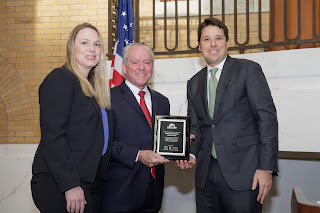
(L-R) Katherine Peters, Director of Residential Energy Efficiency at Eversource, Rep Roy and Chris Porter from National Grid, Director of Customer Energy Management at National Grid
The annual event, co-hosted by the Sponsors of Mass Save (National Grid, Eversource, Until, Berkshire Gas, Liberty, and the Cape Light Compact), celebrated 19 “Climate Leaders” across a range of industries for partnering with Mass Save to make substantial and innovative energy efficiency investments. Representative Roy also received an award honoring him for his unwavering commitment to advancing energy efficiency in Massachusetts.
Collectively, the Mass Save Climate Leaders avoided 47,500 metric tons of CO2, which is equivalent to the amount of energy used by over 6,300 homes in one year. The awardees represented industries across a wide array of sectors such as healthcare; municipalities; community organizations; cultural institutions; hospitality; industrial & agricultural energy efficiency; post-secondary education; developers; the food industry; and school districts.
Among those honored was the Acton Boxborough Regional School District (ABRSD). ABRSD Superintendent Peter Light, formerly Principal at Franklin High School, was at the ceremony on behalf of the district to receive the award.
The ABRSD was honored for their work as one of the first-ever U.S. Department of Education Green Ribbon Schools awardees. Their Boardwalk Campus is a newly constructed, fully electric project that relocated two separate elementary schools into one energy efficient building. With the help of their Mass Save partner Eversource, the project exceeded an Energy Use Intensity goal and installed energy-efficient measures such as ground-source heat pumps, enhanced insulation, demand-control ventilation, energy recovery, as well as a commercial-scale electric kitchen.
Representative Roy spoke at the awards ceremony along with Elizabeth Mahony, Commissioner of the Massachusetts Department of Energy Resources, as well as leaders from Eversource and National Grid, each a Mass Save sponsor.
“I applaud the 2024 Mass Save Climate Leaders for undertaking innovative, climate-driven solutions to reduce their energy use and carbon footprint,” said State Representative Jeffrey N. Roy (D-Franklin). “I especially want to thank the Mass Save Sponsors for honoring me with an award and for their strong partnerships with entities across the Commonwealth to facilitate tangible, measurable, and impactful climate action that moves Massachusetts forward into its clean energy future.”
“I’m happy to be here to celebrate the Mass Save Climate Leaders and their good work to reduce harmful greenhouse gas emissions and lower energy use through efficiency measures,” said Elizabeth Mahony, Commissioner of the Massachusetts Department of Energy Resources. “The 2024 Climate Leaders are undertaking impressive projects including electrification, energy efficient upgrades, sustainable building projects, energy conservation, net zero buildings, and two all-electric geothermal schools.”
“It is our pleasure to recognize the 2024 Mass Save Climate Leaders, all of whom have distinguished themselves as true leaders in our collective missions to help Massachusetts achieve a net zero future,” said Tilak Subrahmanian, Vice President of Energy Efficiency at Eversource. “The impact each has had – individually and collectively – cannot be overstated.”
“Thank you, honorees, for being leaders not just in your industries, but for the entire Commonwealth,” said Christopher Porter, Director of Customer Energy Management at National Grid. “Your commitment to innovation, sustainability, and climate action is a testament to what can be achieved when we all work together towards a common goal.”
In recent years, the Legislature has taken significant steps to help decarbonize the Commonwealth while maintaining affordability and energy reliability.
In 2021, the Legislature set bold goals to reduce emissions with the Next Generation Roadmap Law, which required clean energy and climate “roadmap” plans every five years through 2050 to ensure the Bay State stayed on track.
In 2022, they built on this work by creating clean energy policies and programs to help meet these limits.
Recently, in 2024, the Legislature passed a climate bill which makes historic changes that streamline the state’s siting and permitting processes for clean energy infrastructure projects, and promotes clean energy, battery storage, and electric vehicle policies to build a robust charging network, among many other reforms.
They also passed a climatetech bill which provides significant levels of funding and tax incentives to support the growth of the climatetech industry, making the Commonwealth a competitive hub for this innovative and critical sector. This bill was modeled after legislation that helped launch the successful life sciences industry in Massachusetts.
Governor Healey signed into law sweeping climate legislation to empower the state’s fight against climate change and accelerate progress towards the state’s goals of net zero greenhouse gas emissions by 2050.
Chapter 239 of the Acts of 2024, An Act Promoting a Clean Energy Grid, Advancing Equity, and Protecting Ratepayers, reforms the siting and permitting of clean energy facilities, while responsibly reforming the gas distribution system. It vastly expands the electric vehicle (EV) charging network, incentivizes innovative technologies such as battery storage, fusion energy, advanced metering and meter socket adapters, includes measures to protect residents from high energy costs, and equips state agencies with the mandate to fight climate change.
“Today the Legislature once again took decisive action to address the climate crisis,” stated Senate President Karen E. Spilka (D-Ashland). “While achieving the shared goal of reforming siting and permitting so that we can ensure that clean energy projects get approved and built at the rate necessary to meet our state’s ambitious emissions reduction goals, we are also expanding electric vehicle charging infrastructure and incentives, addressing the high cost and long lifespan of gas infrastructure projects as we strive to move towards cleaner energy sources, and protecting rate payers from bearing the costs of this transformational shift. I am proud that Massachusetts has prioritized passing bold initiatives to address the existential threat of climate change, and I am particularly grateful to Senator Barrett for his thoughtful advocacy on behalf of the Senate throughout this process. I’d also like to thank Majority Leader Creem and all my Senate colleagues, Speaker Mariano, Representative Roy and our partners in the House for getting this important bill across the finish line.”
“This legislation represents the Legislature’s continued commitment to meeting Massachusetts’ long-term emission reduction targets, as it builds on the work that is being done to modernize the Commonwealth’s energy grid, increase clean energy generation, and to combat the climate crisis,” said House Speaker Ronald J. Mariano (D-Quincy). “The reforms related to siting and permitting of clean energy infrastructure will be critical in the process of transitioning the Commonwealth’s energy grid away from fossil fuels over time. I want to thank Chairman Roy and all the conferees, as well as our colleagues in the Senate, for their hard work.”
“To deal with climate change, we need to build up the power supply without swamping the household budget,” said Senator Mike Barrett (D-Lexington), Assistant Majority Leader and Senate Chair of the Joint Committee on Telecommunications, Utilities, and Energy. “People want to keep the electricity coming and they also want to be able to pay their bills. This legislation is about both. Big tip of the hat to President Spilka and Chair Rodrigues. They shoulder the burden of setting priorities for the Senate and finding the needed staff hours. They come through for the climate every time.”
“This legislation advances critical updates for the siting and permitting of clean energy infrastructure, ensuring a supportive and reliable electric grid, and building out electric vehicle charging infrastructure, among so many other things,” said Representative Jeffrey N. Roy (D-Franklin), House Chair of the Joint Committee on Telecommunications, Utilities and Energy. “By overhauling outdated state permitting and siting processes, the Commonwealth aims to secure an equitable, accelerated buildout of clean energy generation and infrastructure that we need to reach our climate goals and power our electrified clean energy future. These reforms are coupled with measured steps to promote solar energy system development, ensure that our gas companies comply with climate targets, procure more clean energy and storage solutions, and use grid-enhancing technologies and advanced meters to increase efficiency, while ensuring that this transition balances consumer safety and system reliability with protections for union workers.”
“This comprehensive climate bill includes a wide range of policies that move us closer to net-zero emissions, including essential reforms to our gas system. By preventing gas investments that are both imprudent and contrary to our climate mandates, the bill will keep costs down and prevent wasteful spending of ratepayers’ hard-earned money,” said Senate Majority Leader Cindy Creem, Chair of the Senate Committee on Global Warming and Climate Change. “This month’s national election results mean that it will likely fall to the states to continue making progress on mitigating and adapting to climate change. Under Senate President Karen Spilka, the Massachusetts Senate has been and will continue to be a leader on climate action.”
“This legislation demonstrates our continued commitment to building a cleaner, more resilient energy future for Massachusetts,” said Representative Richard M. Haggerty (D-Woburn), House Vice Chair of the Joint Committee on Telecommunications, Utilities and Energy. “By cutting red tape in the permitting process, guaranteeing stakeholder participation, and investing in innovative technologies, we’re not just meeting our climate goals—we’re positioning our Commonwealth as a leader in the clean energy economy. This legislation will create jobs, drive economic growth, and ensure a sustainable future for generations to come. I want to thank Chair Roy for his hard work on this, Speaker Mariano for his leadership, and all my colleagues for their strong support.”
Together, the policies transform the future of energy generation, distribution, and consumption in Massachusetts. Major components of the legislation include:
Expediting siting and permitting. The bill consolidates reviews of clean energy siting and permitting, which will speed the pace of planning, constructing, and bringing clean energy infrastructure online to support clean energy technologies such as solar, wind, and storage to create an electrified future and reduce emissions.
Large projects that require state, regional, and local permits will be consolidated into a single permit that requires action within 15 months. Small projects with multiple local permits will also be consolidated into a single permit and require action within 12 months. Each process is modeled on the work of a commission established by the Healey-Driscoll Administration that received extensive feedback from a diverse group of stakeholders.
Expedited permitting is paired with enhanced community review via new offices created by the bill, including the Office of Environmental Justice and Equity, the Office of Public Participation at the Energy Facilities Siting Board, and the Division of Siting and Permitting at the Department of Energy Resources. Each office will be charged with engaging with and providing resources to communities and applicants to ensure a thorough, equitable and community-centered review.
To help protect residents from bearing the cost of building new infrastructure, when possible, the state will require the Energy Facilities Siting Board to first consider maximizing the efficiency of current infrastructure through the use of innovative technologies such as advanced transmission technologies or grid-enhancing technologies before approving new construction. An online clean energy infrastructure dashboard will also be created to promote transparency and public accountability in real time.
Protecting residents from high costs. By pairing lower rates for low- and middle-income consumers with cost-saving infrastructure changes, the legislation protects Massachusetts residents from paying more for electricity.
The bill incentivizes gas companies to pursue the expansion of climate- and cost-friendly networked heat pump systems and geothermal heating, modeled on successful pilots already underway in Framingham and Lowell. It does this by directing the Department of Public Utilities (DPU) to consider greenhouse gas impacts when it weighs a petition by a gas company to expand its territory, reigning in a mandate that historically offered preferential treatment to natural gas infrastructure over other methods of heating. The legislation also saves residents money by considering climate-friendly alternatives to leak-prone pipes instead of automatically replacing them with new natural gas pipes.
To ensure gas workers are protected as reforms to gas distribution system are undertaken, the bill establishes a special legislative commission to study the impacts of the energy transition and decarbonization on the current fossil fuel workforce. The bill further directs utility providers to offer lower rates to eligible low-income and moderate-income utility consumers.
Building out electric vehicle infrastructure. Expanding electric vehicle (EV) use and making it easier to charge a vehicle is crucial to reducing emissions, so this legislation expands the availability of charging stations. Along with making pole-mounted charger installation easier on streets and in parking lots, the bill centralizes statewide coordination of charger installation via the Electric Vehicle Infrastructure Coordinating Council (EVICC). The EVICC will also be responsible for identifying sites for a statewide network of fast charging hubs along Massachusetts highways and major roadways, as well as forecasting EV charging demand and determining its impact on the electric distribution grid over the next ten years. It further removes EV charger installation restrictions for residents who own parcels within condominiums, homeowner associations, and historic districts, and authorizes condo boards to install EV chargers on community parcels.
The legislation extends the MOR-EV program through 2027, giving residents more opportunities to qualify for a $3,500 to $6,000 rebate for the purchase of qualifying new or used electric vehicles. It also makes it easier for cities and towns to procure electric school vehicles—including electric school buses—and EV charging equipment for municipalities. The bill also seeks to dispel misinformation about electric vehicle and electric battery storage safety risks by requiring state guidance on the public health, safety, and environmental impacts of these technologies.
Fusion Energy and Battery Storage. The legislation makes Massachusetts the first state in the nation to add fusion energy to the list of Renewable Energy Portfolio Standard (RPS) Class I renewable energy generating sources, positioning the Commonwealth to be in a strategically beneficial position as fusion energy becomes commercially viable. Additionally, it sets a 5,000 MW energy storage procurement to back up intermittent clean energy resources such as solar and wind. It also authorizes DOER to coordinate with other New England states to consider competitive solicitations for long-term clean energy generation, including existing nuclear generation, for the benefit of the Commonwealth and the region.
Offshore Wind. To support the growing offshore wind industry that will provide clean power and new jobs, the legislation allows future offshore wind contracts to be set for terms of 15 to 30 years instead of the previous 20 year maximum. It also directs the Massachusetts Department of Energy Resources (DOER) to review the effectiveness of existing solicitations in contributing to state emissions requirements and to ensuring high labor standards in clean energy, including offshore wind, clean energy generation, and storage procurements.
It further requires DOER, in consultation with DPU and the Massachusetts Clean Energy Center (MassCEC), to issue guidance on long-term power purchase agreements (PPAs) between offshore wind developers and municipalities, including approved aggregation plans. The bill also expands existing tax credits for offshore wind facility employers, who now only need 50 full-time employees to be eligible for tax credits and refundable credits for capital investment.
Advanced Metering Infrastructure. As demand on the electrical grid increases with the adoption of electric vehicles and heat pumps, advanced metering infrastructure (AMI)—including smart meters, communications networks and data management systems—will enable efficient grid management and improved resiliency.
This legislation supports the rollout of these crucial technologies by requiring the utilities deploying them to create a centralized data repository to provide access to detailed AMI customer data, subject to customer approval. It also authorizes DPU to provide cost recovery for necessary expenses incurred by utilities in AMI implementation. It further maintains consumer protections by establishing an opt-out option for electric customers.
These changes will help companies and individuals use their devices more efficiently and provide real-time data to the grid, allowing for greater flexibility. The legislation also allows customers to install EV chargers or heat pumps without triggering the need for expensive electrical upgrades by authorizing the installation of meter socket adapters to effectively manage increased load.
Solar Energy. This bill establishes new policies to facilitate the deployment of solar energy through updates to historic district laws, providing policy recommendations through a solar canopy working group, and requiring DPU to explore expanding access to net crediting. It also expands affordability and access for low-income customers in the Solar Massachusetts Renewable Target (SMART) program and authorizes the transfer of SMART solar credits to customers in any electric utility territory.
Decarbonizing buildings. Because buildings across the state continue to be a major source of greenhouse gas emissions, this legislation advances efforts to decarbonize them. It authorizes condo association boards to install energy efficiency devices and EV chargers in common areas and increases the efficiency of heat pumps by allowing installers to use the most up-to-date refrigerants.
Supporting lean technology and innovation. To ensure that the next generation of technology is built in Massachusetts, the legislation will expand support to the state’s innovators. The legislation does this by expanding the purview of MassCEC to include carbon removal, embodied carbon reduction, and nuclear power. MassCEC is also directed to promote carbon removal and embodied carbon activities, and study opportunities for future carbon removal.
Leading by example. The legislation directs the state to analyze its own climate impacts and how state infrastructure can be more climate friendly. It directs the Division of Capital Asset Management and Maintenance (DCAMM) to evaluate the climate impacts of state buildings and seek options for emissions reductions, and directs Massport to prioritize reducing emissions while pursuing commerce and growth. It also expands the mission of the Board of Building Regulations and Standards to include reducing emissions and embodied carbon.
The candidates in the 10th Norfolk District State Representative race agreed to participate in an online debate — responding to questions suggested by Observer readers — in writing, in the Observer. One question and the candidate’s respective responses will be published for a total of seven weeks leading up to the election.
Here is question number 7 and Rep. Roy’s response on housing for seniors.
What can or should be done to provide housing for seniors that is actually affordable (as opposed to 55+ housing that still requires a robust middle- to upper-middle class income)?
Housing for seniors has been a priority for me and the legislature and we have taken bold action on that issue. In August, the Legislature passed the Affordable Homes Act, the largest housing investment in Massachusetts history and a powerful first step in tackling the state’s housing affordability crisis. The legislation authorizes $5.16 billion in bond authorizations and tax credits to spur housing production in Massachusetts, while implementing sweeping policy initiatives to facilitate the development of affordable housing and preserve public housing in Massachusetts.
Among the many policy initiatives included in the bill to create more housing, particularly for seniors, is a provision to permit one accessory dwelling unit (ADU) equal to or less than 900 square feet to be built by-right on a property in single-family zoning districts in all Massachusetts communities. This will allow seniors the option to stay with their property, stay in their community, and offer a younger generation or other family members to live there as well.
The bill also includes $2 billion to support the repair, rehabilitation, and modernization of over 43,000 public housing units across Massachusetts, with 25 per cent of the funds dedicated to preserve housing for those with incomes below 30 percent AMI. Our public housing also includes a large population of seniors and this funding will help support more housing for seniors.
The bill also includes $200 million to support Local Housing Authorities (LHAs) who partner with developers to add mixed-income developments on LHA land, leveraging funds to maintain and preserve public housing while increasing the overall housing supply.
There is an additional $200 million to support innovative and alternative forms of rental housing, including single person occupancy (SPO) units, transitional and permanent housing for people experiencing homelessness, housing for seniors and veterans, and transitional units for persons recovering from substance use disorder. Twenty-five per cent of funds must be used to fund projects which preserve housing for those with incomes below 30 per cent AMI. In the bill, there is also $60 million to modify homes of individuals or families with disabilities or seniors so that they may maintain residency or return home from institutional settings.
We also doubled the Affordable Housing Trust Fund to $800 million, doubling the Housing Innovations Fund to $200 million and nearly tripling the Housing Stabilization and Investment Fund to $425 million included which provides resources to create or preserve affordable housing for households earning less than 100 per cent of AMI and $200 million to accelerate the development of mixed-income multifamily housing.
The bill also establishes an Office of Fair Housing and Fair Housing Trust Fund, mandating the establishment of a statewide housing plan, and establishing special commissions on extremely low-income housing, senior housing, and accessible housing for persons with disabilities.
Locally, we included the following funding in the bill which is targeted for senior housing in Franklin:
$3,000,000 shall be expended for the Franklin Ridge senior housing project; and
$1,000,000 shall be expended for the Franklin Housing Authority
I’m incredibly proud of the investments included in this bill, which together make the largest investment in affordable and middle-income housing in the history of the Commonwealth. Given that Massachusetts is one of the most expensive states in the entire country to buy a home or rent an apartment, the funding and tax credits provided by this bill will be crucial as we work to ensure that every Massachusetts resident can afford to live here, work here, and raise a family here, and seniors aren’t priced out of communities where they want to live.
As we enter into the final days of the campaign, I invite readers to view the video below which highlights work we have done together over the past 12 years.
In addition, I invite you to view the graphic below which also highlights our work together on behalf of Franklin and Medway.
I thank you for your continued support and ask for your vote on Tuesday, November 5.
The candidates in the 10th Norfolk District State Representative race agreed to participate in an online debate — responding to questions suggested by Observer readers — in writing, in the Observer. One question and the candidate’s respective responses will be published for a total of seven weeks leading up to the election.
Here is question number 6 and Rep. Roy’s response on the override question.
What is your position regarding bringing back another override vote in Franklin and why?
It is vital that community members have the opportunity to express their opinion about whether they want to raise taxes above the levy limit set by Proposition 2 ½. A vote on this question allows the residents — the investors in the community — to weigh in on a matter of direct consequence to them.
While Proposition 2 ½ places constraints on the amount of the levy raised by a city or town and on how much the levy can be increased from year to year, a community can permanently increase its levy limit by successfully voting an override.
Our community rightfully has high expectations for the delivery of local services and the academic performance in our schools. As Franklin residents, we elect a Town Council and School Committee to help us meet these expectations through an annual budget and present us with options when the budget falls short of these expectations.
In the case of budget shortfalls, the town leaders can elect to make budget cuts or allow the citizens to vote on raising the level limit through an override. The discussion on an override question should center on whether the community finds these cuts acceptable, or whether they are willing to pay more for the critical services they expect and deserve. Those decisions are best left to the voters.
A fundamental building block of our democracy is the right of citizens to vote and thus an override, if our town leaders deem it a viable option, should be decided at the ballot box.
The candidates in the 10th Norfolk District State Representative race agreed to participate in an online debate — responding to questions suggested by Observer readers — in writing, in the Observer. One question and the candidate’s respective responses will be published for a total of seven weeks leading up to the election.
Here is question number 5 and Rep. Roy’s response on the Voter ID question.
5) Voter ID has been a topic of controversy. Some say, IDs are required for almost every kind of activity in our society, so why should a critical civic responsibility be any different, even if only to help assure citizens that the election system is secure? What is your position and what actions have you or would you take in this regard?
Our right to vote is the backbone of American democracy. That’s why so many citizens have risked or lost their lives to protect and realize that right as intended. It’s important to protect the integrity of our elections, but we must be careful not to undermine free and fair access to the ballot.
And it is important to ALL OF US that our elections be fair, clean, and well run. I have all the confidence in the world that our Town Clerks in Franklin and Medway are doing an incredible job ensuring that the people who vote are the people who are eligible to vote. To my knowledge, there has never been voter fraud in our district. And a 2019 study of national behavior found voter ID laws have a negligible impact on voter fraud, which is already extremely rare.
Eligibility to vote in the United States is governed by the United States Constitution and by federal and state laws. Several constitutional amendments (the Fifteenth, Nineteenth, and Twenty-sixth specifically) require that voting rights of U.S. citizens cannot be abridged on account of race, color, previous condition of servitude, sex, or age (18 and older).
Though state laws requiring some sort of identification at voting polls go back to 1950, no state required a voter to produce a government-issued photo ID as a condition for voting before the 2006 elections. Indiana became the first state to enact a strict photo ID law, which was struck down by two lower courts before being upheld in Crawford v. Marion County Election Board by the U.S. Supreme Court.
In 2005, a national commission, chaired by former President Jimmy Carter and former Secretary of State James Baker, studied the issue and recommended that States should require voter photo IDs. See Report of the Commission on Federal Election Reform, Building Confidence in U. S. Elections, App. 136-144. This ID requirement is purportedly intended to prevent “voter fraud,” and yet the Report itself concedes that “[t]here is no evidence of extensive fraud in U.S. elections or of multiple voting” before asserting, without any meaningful support, that “both occur.”
The Carter-Baker Commission conditioned its recommendation upon the States’ willingness to ensure that the requisite photo IDs “be easily available and issued free of charge” and that the requirement be “phased in” over two federal election cycles, to ease the transition. Carter-Baker Report, App. 139, 140. It also conditioned its recommendation upon the States’ willingness to ensure that the requisite photo IDs “be easily available and issued free of charge” and that the requirement be “phased in” over two federal election cycles, to ease the transition. Carter-Baker Report, App. 139, 140.
Pennsylvania’s voter ID law adopted in 2012 allowed various forms of photo identification cards, including those held by drivers, government employees, in-state college students, and residents of elder-care facilities. Voters who do not possess these forms of identification can obtain voting-only photo IDs issued by the Pennsylvania Department of State through the Pennsylvania Department of Transportation (PennDOT). The law was challenged and following a trial in the summer of 2013, it was struck down on January 17, 2014 as violative of the constitutional rights of state voters. The ruling noted that required alternative voter IDs were available only through 71 PennDOT Drivers Licensing Centers across the state. Five of the 71 DLCs are located in Philadelphia, nine counties have no DLCs at all, and DLCs have limited hours: in nine counties they are open only one day per week, and in 13 counties they are open only two days per week. The court ruled that the state provided too little access, no financial support to provide IDs to those without access, and no alternatives to obtaining the required IDs. Thus, photo IDs are not required to vote in PA.
Voter identification laws have become the subject of intense partisan conflict and numerous legal challenges in recent years. Proponents say the laws are necessary to prevent voter fraud. Opponents say there is little fraud of this kind, that the burden on voters unduly restricts the right to vote, and that the laws impose unnecessary costs and administrative burdens on elections officials. All voters, regardless of the type of verification required by the states, are subject to perjury charges if they vote under false pretenses.
Against this backdrop, I would support voter ID laws that are not designed to suppress the right to vote and if the IDs are easily available and issued free of charge. It is important to note that as many as 11 percent of eligible voters do not have the kind of ID that is required by states with strict ID requirements, and that percentage is even higher among seniors, minorities, people with disabilities, low-income voters, and students.
In Massachusetts it is already the law that you may need to show identification when you check-in at your polling place if:
You are voting for the first time in Massachusetts
You’re on the inactive voter list
You’re casting a provisional or challenged ballot
The poll worker has a practical and legal reason to ask for identification
Identification needs to show your name and the address where you are registered to vote. Examples of acceptable identification are:
A driver’s license
A state ID card
A recent utility bill
A rent receipt or lease.
A copy of a voter registration affidavit
A letter from a school dormitory or housing office
Any other printed identification which contains your name and address
I believe that the current Massachusetts law is adequate and see no basis for making further changes. If presented with evidence of voter fraud, however, I would push for changes.
The candidates in the 10th Norfolk District State Representative race agreed to participate in an online debate — responding to questions suggested by Observer readers — in writing, in the Observer. One question and the candidate’s respective responses will be published for a total of seven weeks leading up to the election.
Before addressing question 4, I need to address continued lies proffered by my opponent on the issue of migrants over veterans in his answer to question #3 and in written materials he has circulated. I have repeatedly corrected him, but he continues to put out false information. I covered the issue in an op-ed piece which you can view by clicking here, and in comments at the Franklin Town Council several months ago which you can view by clicking the video below:
Here is question number 4 and Rep. Roy’s response on the SNETT Trail and its expansion into downtown Franklin.
3) What can be done or should be done to extend SNETT to downtown Franklin? How and when?
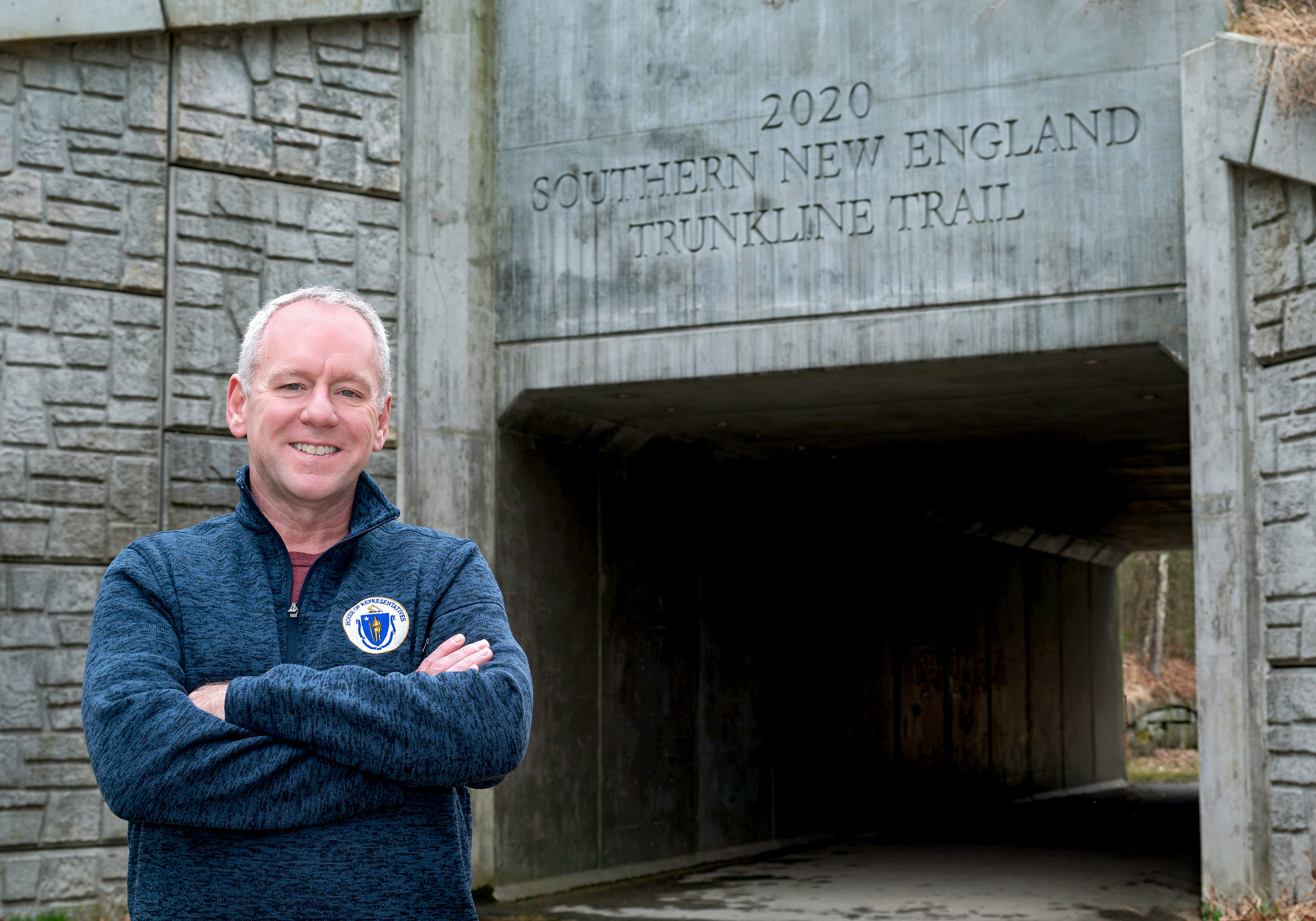
The SNETT trail and its improvement and expansion to Union Street have been long time priorities for me. After successfully completing the tunnel under Prospect Street in 2020, I have been focusing on the extension of the trail into downtown. The project is highlighted as a priority in both the Town of Franklin Master Plan and FBRTC Master Plan.
Evoto
In 2022, I filed an amendment to the ARPA funding bill to secure $700,000 for the project. The amendment passed and Franklin received the funds from the Department of Conservation and Recreation (DCR) in May 2022.
The land is currently owned by CSX, so I reached out to Congressman Jake Auchincloss to get his assistance in setting up a meeting with company officials. On July 26, 2023, I traveled to Washington, DC to meet with the CSX President and Chief Executive Officer Joseph R. Hinrichs and Congressman Auchincloss. We opened discussions about securing the land and following that conversation, the land has been offered up for sale.
I anticipate that the sale will take place soon and that the 1.6 miles will become part of the SNETT system.
The SNETT trail is a 22-mile multi-use path that runs through 6 towns from the Franklin State Forest to the Connecticut border in Douglas, following the former New England & New York Railroad line. It is designated a Heart Healthy Trail and is one of the longest trails in Massachusetts. It is used year-round for various activities by people of all ages and abilities. The current Franklin trailhead resides on Grove Street, a small parking lot on an industrial road. The rail bed itself continues to Franklin’s Downtown – where it meets up with an active commuter rail line (between the Dean and Forge Park stops on the Franklin line).
The extension of the last 1.6 miles of the trail has the potential to dramatically transform the transit and economic development opportunities for Franklin and the surrounding communities. In addition to the environmental amenities of the property – which includes an extended overlook of Spring Pond, a federally-protected wildlife conservation area – the extension would unlock tremendous opportunity for improved accessibility and appeal of the trail. The 1.6-mile stretch will transform SNETT from a hidden recreational asset into a regional destination for families and adventurers alike.
The candidates in the 10th Norfolk District State Representative race agreed to participate in an online debate — responding to questions suggested by Observer readers — in writing, in the Observer. One question and the candidate’s respective responses will be published for a total of seven weeks leading up to the election. Here is question number 3 and Rep. Roy’s response on the “right-to-shelter” law and steps to mitigate a crisis.
3) Regarding, shelter for migrants, many attracted to Massachusetts by an extremely generous ‘right to housing’ law and/or brought to the state with the help of NGOs. What can or should be done to keep this from becoming a real crisis, to protect the state budget, and to protect local towns from the many disruptions this has caused.
Massachusetts has a “right-to-shelter” law, which for 40 years has required state officials to quickly provide shelter and other necessities to homeless parents with children and pregnant women. You can find the text of the law by clicking here and here.
Each day, we in government are called upon to help people who find themselves in difficult situations. My faith and upbringing taught me that we should help others to help themselves and I use that as a foundation in my work. “To whom much is given, much is expected” is another phrase that is also foundational for me and is a reminder that we should use our blessings to help others.
In August 2023, a large influx of migrant families arriving in Massachusetts led to the Governor declaring a state of emergency. We are doing the best we can to address this crisis and here are some of the actions that we took to protect state and local budgets:
Caps, Reforms, and Reporting on Shelter Law: We put caps in place on the number of persons served and we have required the Governor to provide reports and data on her implementation of the shelter program. The Healey administration’s initial shelter report to the Legislature was filed on December 18, 2023. The latest report filed on September 9, 2024 indicates that currently Franklin is housing 90 families and Medway is housing 12. It also shows that 3,929 of the migrants have work authorizations and are receiving appropriate job training. On Tuesday, the Boston Globe reported on the success story for a small human services nonprofit in Marlborough who, for the first time in a decade, has all of its full-time direct-care jobs filled because it was able to hire dozens of new arrivals from three local shelters. The story went on to note:
Since last November, around 3,000 people in the emergency shelter system have landed jobs, according to the state, which recently announced it was expanding job training programs for shelter residents. In all, more than 5,100 migrants have gone through the convoluted process of applying for work authorization.
New arrivals are working in manufacturing, hospitality, food prep and service, retail, senior care, and health care support — assembling parts, stocking shelves, cleaning hospital rooms, andwashing dishes. These are the kind of low-wage, physically demanding jobs many Americans aren’t willing to do, employment specialists say.
The legislature also provided targeted funding to support families exiting the shelter system and modified the right to shelter law by putting reasonable limitations on the length of time families can remain in the program. We created a recurrent certification requirement to ensure program participants are complying with eligibility requirements and established a commission to study the future of the shelter program. We also provided funds for workforce training programs and tax credits for companies that provide job training to Emergency Assistance (EA) participants.
Further, we mandated that the Healey administration create a rehousing plan and provide case management for all individuals in shelters to help them successfully exit the program. Beginning June 1, 2024, the total length of stay would be limited to nine months, at the end of which families would be eligible for up to two 90-day extensions. Extensions would be based on circumstances that include employment or participation in a workforce training program, veteran status, imminent placement in housing, avoiding educational interruptions for children in public school, pregnancy or having recently given birth, diagnosed disability or medical condition, a single parent caring for disabled child or family member, a single parent without adequate childcare, and risk of harm due to domestic violence.
Expand Federal Assistance and Reform Federal Immigration Law: The state cannot shoulder the burden alone. Massachusetts is working with federal authorities to secure more financial aid and resources to support migrants. We have also been pushing for changes to immigration laws to slow the influx of migrants, but Senate Republicans, at the urging of Donald Trump, blocked the debate on the bipartisan Border Act (for another story, click here and see the video below), which would have rushed enforcement resources to the border, tightened asylum standards, expedited the removal of those who abuse the asylum system to enter the country unlawfully, and hired more Border Patrol officers. For details on what the bill would have done, click here.
Invest in Long-Term Housing Solutions: Temporary shelters are costly and often strain local resources. A more sustainable solution involves investing in affordable housing initiatives and infrastructure, creating pathways for migrants to become self-sufficient. By addressing the housing shortage in the state, Massachusetts can ease the pressure on emergency shelters. We passed a comprehensive housing bill in July 2024 which addresses this and many other housing issues.
Limit Impact on Local Communities: Towns experiencing disruptions from the influx of migrants need support. The state is providing funds to municipalities for local services such as schooling in the amount of $104 per day for each migrant child in the system. In addition, the state maintains a dashboard with resources and data on the Emergency Assistance family shelter program that you will find by clicking here. I keep in close contact with local officials to address any concerns they may have with the program.
By tightening policies, securing federal support, and focusing on long-term solutions, Massachusetts can mitigate the budgetary and social strain caused by the current shelter system while also serving those in need and protecting local communities.
In 1974, something was bugging the second graders at Kennedy Elementary School in Franklin. They were puzzled that among all the symbols in the Commonwealth, there was no state insect. Since ladybugs are considered good luck and protect plants from pests without being harmful to gardens, the children and their teacher considered the insect worthy of becoming the Bay State’s official state bug.
These second graders swarmed the State House while wearing homemade ladybug costumes and visited lawmakers to make their case. After some heroic efforts by these pioneering students and their teacher, involving a petition, testimony before a legislative committee, and letters to legislators, the ladybug becamethe official state insect in 1974.
On Friday, October 4, 2024, the same ladybugs, along with family and friends, will return to the State House for a 50th Anniversary celebration and tour. Organized by State Representative Jeffrey N. Roy (D-Franklin), the Ladybugs will also meet and have their picture taken with Governor Maura Healey. They will be also joined by the family of their teacher, the late Palma Johnson during the State House visit.
“Although five decades have passed since H.5155, An Act designating the Ladybug as the official bug of the Commonwealth, was signed into law, the passage of time has not diminished the importance of their achievement and timeless inspirational story,” said Representative Roy, “Their efforts and dedication in 1974 showed how anyone with a good idea can affect change. It was the ultimate civics lesson for these students and we will celebrate their accomplishment on Friday.”
One of the students in the class took that civics lesson to heart. Twenty years after the bill signing, Jim Vallee was elected to the Massachusetts House of Representatives where he served Franklin for 19 years. He is expected to attend the anniversary event on Friday.
Their historic accomplishment by the Franklin students is now part of the State House lore and is featured on its website (click here) and celebrated in a booklet distributed in the building. The accomplishment was also featured several years ago on an episode of WCVB’s Chronicle which you can view below.
The candidates in the 10th Norfolk District State Representative race agreed to participate in an online debate — responding to questions suggested by Observer readers — in writing, in the Observer. One question and the candidate’s respective responses will be published for a total of seven weeks leading up to the election. Here is question number 2 and Rep. Roy’s response on policymaking, negotiations, experience, and successes.
2) Can you provide an overview of your approach to policymaking and legislative negotiations. In other words, is there a general perspective you bring to this or would bring and how do you or how would you negotiate to get support. Relatedly, what experience do they have in navigating these types of negotiations, including their successes.
My approach mirrors what I have done as a trial lawyer and local government official. It involves meticulous research and meetings with stakeholders and experts, listening closely to develop a rich understanding of the issues.
The job is also about being there for the people of your district and bringing home local aid to let folks know you have their back. I know who to call and have used my resources to help Franklin and Medway residents solve problems concerning unemployment, healthcare, human services, housing, veteran affairs, pensions, and other issues involving state agencies.
I worked with officials and families to form the SAFE Coalition, to help with the substance use disorder crisis. And I help entrepreneurs, non-profits, and manufacturers so that our economy can thrive, and workers can find good jobs.
The graphic below highlights my experience and successes:
My website at jeffreyroy.com and the video below amplify that approach and perspective.
The answers to question number one on reforming the Massachusetts State Police can be found by clicking here.
The candidates in the 10th Norfolk District State Representative race agreed to participate in an online debate — responding to questions suggested by Observer readers — in writing, in the Observer. One question and the candidate’s respective responses will be published for a total of seven weeks leading up to the election. Here is question number 1 and Rep. Roy’s response on reforming the Massachusetts State Police..
1) What do you think needs to be done to reform the Massachusetts State Police? Or, what would you try to do as a legislator to reform the State Police?
The legislature has, and will continue to use, a multi-faceted approach that emphasizes transparency, accountability, and modernization of the State Police.
In 2020, the legislature passed a new law that includes a certification system for police officers, public access to police misconduct investigation records, and reporting of police violence. It also established four permanent commissions, increased accountability and transparency in law enforcement, and gives police departments a greater ability to hire or promote only qualified applicants.
The legislation included key provisions of the State Police reform legislation that the Baker administration filed, including tools to improve accountability and discipline within the department. The language gave the governor, for the first time, power to pick someone from outside the ranks of the State Police to helm the agency. And Governor Healey used that new authority to hire Geoffrey D. Noble of New Jersey earlier this month.
The new law also creates a new civilian-led police oversight board – the Massachusetts Peace Officer Standards and Training Commission – with subpoena power and decertification authority. The nine-member independent state entity has the authority to establish policing standards, certify law enforcement officers, investigate allegations of misconduct, and suspend or revoke the certification of officers who are found by clear and convincing evidence to have violated its standards.
On training and education, the Massachusetts State Police Academy provides extensive training opportunities to new recruits and in-service law enforcement. I have toured the facility and participated in the training to see firsthand how the best practices are implemented.






 jeffreyroy.com